Showing posts with label scouting. Show all posts

Tuesday, September 16, 2014

Hunt Report - 9-14-2014

Scout. Hunt. Scout. Hunt. Scout. Scout. Scout. Scout. Scout. Season over. 

Well, at least that's how it feels. My hunting trips are really just glorified scouting trips, only I carry a shotgun, game bags,  and an ever-diminishing sliver of hope. I suppose the scouting is necessary due to my limited knowledge of the area, but the endless walking and the noise that comes with it obliterates any reasonable chance of taking a bear.  

This is one of my great weaknesses when it comes to hunting: I love to explore (cough: scout), and I justify this obsession by convincing myself that the area just over the next ridge could be bear mecca. Of course, that's hardly ever the case. More likely, as I am quickly discovering, it's just a bramble of maples and birches with little to no bear sign. 

Sunday was no different. My plan was to hike four miles in to a prominent saddle, spend the morning overlooking the saddle, and then slowly work my way back to the truck doing calling sets every half mile or so. I had never been to the saddle before but was convinced that it must surely funnel wildlife between the two drainages. Arriving a bit late to the trailhead, daylight found me an hour into the hike, with still another hour and a half left to hike before reaching the saddle. When I did finally arrive, I was sorely disappointed: there was nothing of great significance. I probably should have been more vigilant in trying to locate sign, but the area simply did not have that magical feel and I figured my time would be better spent elsewhere.

After a brief snack, I headed back down to the (Beaverkill) River. That took about another hour or so, during which I second-guessed my decision to hike to the saddle in the first place instead of simply hunting one of the areas where I had previously found some sign of bear. It was roughly 11 o'clock when I arrived at the river. Feeling slightly defeated and overly exhausted, I decided to take a nap, which I managed to successfully do for the better part of an hour. This would remain one of the few successes of the day. 

Once I woke, I decided to follow the river until it concluded just at the edge of some private property. However, I got confused when I crossed a stream that I thought was indicated on the map, making me believe I had hiked much further than I had actually done. So I turned back and by the time I had discovered my mistake I had gone too far to backtrack. That area is still on my scouting list.

At that point, I decided to call it a day and go spend some time with the family rather than aimlessly wandering around the woods. In other words, I was defeated. I still had yet pull the trail camera though, and so I made my way in that direction. I arrived at the camera about 2:30 and sat down to have lunch before heading to the truck. While eating I realized I could view the trail camera pics by placing the memory card in my regular camera. Much to my surprise, there I found one photo of a mother bear and her cub, apparently grazing the berries that lay in front of the camera. 

The sight of bears at the very location I was standing gave me a great boost in confidence and made me think I should do a calling set close by in hopes of pulling in a bear, though not the ones in the photo since it is illegal to take any bear that is with another bear. 

After getting setup, I called for about 30 minutes. Nothing showed. This was of no surprise. My calling is quite terrible, and at one point I actually felt guilty for subjecting every animal in a half-mile radius to my pitiful and obviously manufactured rabbit distress call. After waiting another 30 minutes for nothing to appear, I headed for the truck and arrived there at 6:30. That was my day. Lots of walking, and very little hunting. I suppose I can't expect much when that is the case. This is doubly true due to missing the morning and evening hunting periods, easily the best time to be situated in a stand and actively hunting. 


The camera was in place for eight day. This is the only picture that captured wildlife. This is a mild success. Four weeks ago I had yet to step foot in any of the Catskill Parks. That I can locate bear, an animal I have never hunted before, in a somewhat vast park is definitely an accomplishment. However,the cynical side of me won't let myself celebrate for too long. Had I hunted everyday that week in this exact location I would have only seen two bears, neither of which I could have killed. That's not the best of odds so to speak. 

And now on to more photos.


The open marsh just left of where the bears were photographed. 


Tough to see in the photo, but the vegetation is beaten down.


I'm trying to be more observant with sign. Here I think the ends of some berry bushes have been broken off. 


Not the best print for identification purposes. When I first found it, I was 50/50 on whether it was a bear, though not sure what else would have an imprint like that. Then I pulled the trail camera that was forty yards away and found the photo with the bears. 

Sunday, September 7, 2014

Hunt Report - Bear Opener

To the wilderness . . . 


Unsurprisingly, I woke up a bit late Saturday morning and didn't make it to the trailhead until an hour after first light. Nothing is more defeating to me than arriving late to a hunt, particularly a morning hunt for bear when the best time to be in the woods in the first two hours or so. The hike from the trailhead to Tunis pond takes me about 1 hour and 15 minutes to complete and I figured it would take another 30 minutes to setup once I got there. So in all, I was 2 hours and 45 minutes late. Not the best start to the bear season. To make matters worse, I was feeling the aches and pains that come with only getting four hours sleep. Feeling a bit defeated, I decided to make it a day hunt and quickly went through my pack  for things to leave at the truck. At the mile mark, I could tell my pack was way too heavy, particularly for a day hunt. The smart thing to do would have been to stash some of my items along the trail, but somehow that thought never entered my mind. 

By the time I got to Tunis Pond, I was ready to shed the pack. Having barely scouted Tunis on the last trip, I took the blown hunting opportunity to thoroughly scout the area. Shedding the pack, I began to scout around. I was hoping to find that smoking gun of fresh sign--steaming piles of scat, a well worn trail, a rubbing tree, etc--that would tell me inconclusively where to place my stand and give me great confidence going forward. There would be none of that. Aside from a few piles of old scat, I found next to nothing. There are some trails, but I'm unsure if they are being used by bear. I did set a trail camera on one of these trails, but it was mostly because I was tired of hauling the weight around and I don't expect to see much come next week when I pull the camera. 

With little if any sign, I decided to head further down the trail and follow the Beaverkill river once it splits from the trail. The hike from Tunis to the Big Indian Wilderness boundary (where the trail and river split) is spectacularly beautiful. I didn't find much sign along the Beaverkill, but I didn't go very far either. The habitat is intriguing. It feels bearish. As a last resort, I did one calling set, mimicking the sound of a distressed rabbit for the better part of forty minutes. I haven't practiced this type of calling before, and my inexperience was very noticeable, at least to the human ear. At one point, two bluejays joined in the chorus, which left me wondering why two bluejays were so interested in my call, and then I realized that the cadence of my calling sequence and the pitch of the call sound disturbingly close to the sound of an alarmed blue jay. Needless to say, I wasn't swarmed by bears. 


A few faint tracks in the sand did catch my attention.  At the time, I thought they were bobcat tracks, but after reviewing it further I believe it is indeed a bear track. If so, there are bear in the general area (this is the second set of track in the area), just not a lot of them and for any length of time. If I was hunting every day, I might be tempted to sit over a trail in hopes of catching one of these bears as the travel through the area, but I'm only hunting one or two days a week and I'm guessing the bears make a pass through the area about once a week. It's obvious to me then that the chances of me and the bear being at the exact same spot at the same time are quite slim. So I have hatched a new strategy, which is basically cover a much ground as possible, doing calling sets every half mile or so. So I have a week to improve my calling. We'll see. 


 The track that I think is a bear along the Beaverkill River.

Another view of the track that I think is a bear track.


Marshy area along the Beaverkill River where I made my calling set.


Just inside the marshy area where I made my calling set.


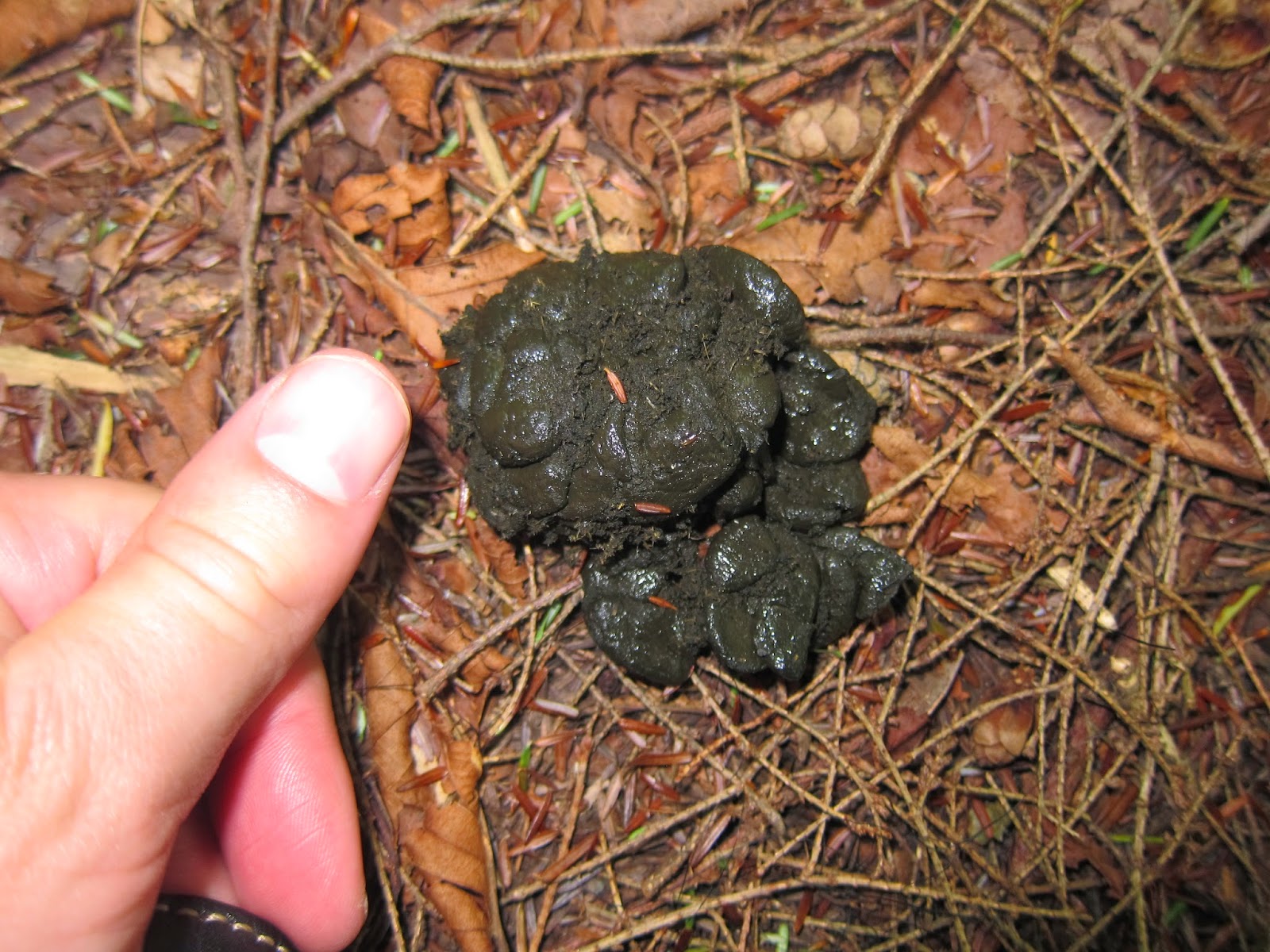
What's a blog post without pics of scat? I read that when you come across scat from a big bear that it is unmistakable. I think this qualifies.


Wednesday, September 3, 2014

Scouting Report - Balsam Lake Mountain Wild Forest

As promised, here goes nothing . . . . 


Headed up to the Balsam Lake Mountain Wild Forest the other day to scout for bear.
This was my third trip to the area. My  first trip, which I partly document here, was less than productive, though we did find some bear sign . For this trip, I relocated about three miles northeast to Balsam Lake Mountain Wild Forest trailhead at the end of Beaverkill Road (google maps shows it turning into Turnwood Road). I had found a couple small lakes on the map about two miles from the trailhead just off the Finger Lakes Trail. These turned out to be Vly Pond and Tunis Pond. I'm just a rookie when it comes to bear hunting, but my understanding is that bears love water and the often rich food sources its fringes hold. In this case, the open area in the forest canopy has to be good for forage. At the very least, I figured it was worth a shot. That's really all a person can do:  identify areas from a map that look intriguing and then groundtruth those suspicions by putting boot to trail.

As I mentioned before, two miles probably eliminates just about 95% of hunters. So if Tunis held bear, I figured it was the perfect scenario:  some type of habitat attraction or wildlife corridor that is just outside most hunters' range but well within my own. That it is easily accessed via hiking trails is a bonus. I didn't time my hike but I would guess it took me less than an hour to hike from Tunis to the trailhead (i was scouting on the way in). It's not the most physically exerting trail, but it does have its elevation gains that do get the heart rate moving at a decent clip (this is doesn't require much; I'm not in great shape these days). The forest is typical for the area:  maples, birches, and hemlocks with a few beech trees in the mix as well. 

Just before Vly Pond the trail crosses a dirt road. This was a surprise to me and my first reaction was utter despair. There were recent tire tracks on the road, and I figured someone had grandfathered rights to the road. Worst case scenario being that that someone is a hunting club. I still don't know, but my fingers are crossed. About a 1/2 mile after Vly Pond the trail intersects another road that the trail terminates into. The signs at the intersection give distances to the nearest locations, but do not provide directional arrows. I was unsure if I needed to turn left or right to stay on the trail. I had read that ownership rights along the Beaverkill River can be a bit confounding, and I didn't want to trespass on private property and have to deal with that headache. Luckily, I had preprogrammed coordinates into my GPS for Tunis Pond before heading out. A quick check of the GPS revealed that left led to Tunis. Still, the trail is essentially an old road, and I couldn't shake the feeling that I was on private property and should have instead made a right. 

Tunis is another .25 mile or so after the turn (left). It's a beauty of a lake, and I found a fair amount of bear sign in the area, including a very fresh track. Most of the sign was on the backside of the lake along a well established trail, though I believe the trail is more the domain of deer than bear. The boggy area surrounding the lake holds some kind of small blackberries (blush, I don't know the name and I didn't take a picture). The hillside surrounding the lake is choked full of hazelnuts, with a few beech trees in the mix. In other words, it's got food aplenty. I got that tingly feeling I often get when I have found a prime location. At one point in my life, I would suppress that feeling and write it off as wishy-washy humdrum. Then I would unexpectedly spook an animal from the area and kick myself for not paying more attention to my gut feeling. I no longer ignore that gut feeling, and so, I will be hunting around Tunis Pond this Saturday for the opening day of bear season. I don't expect to get anything or, for that matter, even see anything. However, as the adage goes: you don't get anything sitting on the couch. 

Being a rookie and all, I don't put much confidence into my bear sign interpretation skills. Below are some pics of sign I found. They are organized by how confident I feel in them being bear sign. 

Sign I feel sure about:


Yep. Bear track.


Ditto


  At least a couple months old. Interestingly, I think those are acorn shells. Yet I didn't see any oak trees in the area. If those are acorns, then I'm guessing the scat is from the fall. It was solid.


Ditto

Less sure about:


Doesn't get any fresher, but is it bear scat? The picture is deceiving. The scat is actually much larger, it just sank into the bog upon impact. 


Fresh, small, and globbish. Deer or Bear? 


Fresh and biggish, but not huge. Still, I think it's bear scat. I've never seen deer scat like that. Why am I doubting myself?


Path of travel. Do you see swerving type gant of the animal. It's not as noticeable  in the picture, but it doesn't have straight and linear pattern of a deer.

Gots Me?


Pretty large throw area, but I suppose just about any critter can throw dirt. 


Bear scratching? Or rotting tree?


Deer scat, right?


Scratching post? Or just some worn bark? I should have looked for hair.

That's it. Thanks for reading!

Sunday, November 11, 2012

Private Land

(Note: there are no pictures in this post due to a really big buck tricking me into leaving my camera on my truck seat. Yes, they have that effect. I'll try to post pictures later this week).

About a month ago, a very generous friend offered me access to her land. I've been itching to hunt private land since moving to NY three years ago. Still, the timing of the offer was off. School was ramping up, deer season was well underway, and any time spent scouting a new spot and setting stands meant less time hunting the Remote 40 spot I had worked so hard to find over the summer. 

But I'm not dumb. Obtaining permission to private land is probably the single greatest thing you can do to ensure a full freezer. So, in mid-October we did a walk around the property. It's about seventy acres, but only about eight acres are wooded. The rest is agriculture fields, save about five acres of abandoned & overgrown field. The ag fields were harvested, but the farmer had applied a clover cover crop. 

As any hunter worth their salt will tell you, where there is clover there is deer. On the walk around, there was plenty signs of deer, but most of the rubs were a year old and the main trails were in wet areas, which makes it difficult to tell just how much the deer are actually using them. Plus, the land surrounding the property was almost entirely cornfields and they had already been harvested. 

Here was my initial thought process:

1) Clover = Deer
2) No cover (due to harvested cornfields) = Nocturnal Deer
3) Damn. Life story. Day late and a dollar short. No point hunting nocturnal deer. 

Well, I returned today (as should be readily apparent from the lack of posts, school has won the annual college vs. hunting bout, as it usually does). Not that I'm still not buried in work, but I had an itch to go hunting.

Here's a timeline of today's events:

2:00 -  Arrive

2:02 -  Huge buck standing 150 yards from the house. He's either a really big eight point, or       a big ten or twelve pointer. Big-bodied deer. I decide to try an circle out ahead of him.

2:15 - Forty yards from truck, kick up doe.

2:30 - Decide its best to leave the buck alone and get my stands set. Best not to spook him in some stupid attempt to stalk him. 

2:45 - Reach the back woodlot. It's loaded with about 15 scrapes and countless rubs. Some of the rubs are on trees larger than I can get my hands around. They're high on the tree too. The scrapes are bare of leaves but look a little old. Maybe the rut has passed?

3:00 - Spot deer in field. Move to get a closer look and wind in face.

3:20 - Deer hundred yards off. Wind in face.

3:22 - 3 more deer in field. All does. Decide four pairs of eyes are too much to stalk.

3:45 - Deer leave field. 

3:50 - Another deer appears about 150 yards off. Doe. It leaves within 5 minutes.

4:00 - Set stands at field edge where deer were. More scrapes and rubs. 

4:01 - Kick self for not hunting here all season. Not that I could have due to school work, but what a missed opportunity.

Anyway, now I got a really bad itch to go hunting. Like a drop out of school itch. Due to a design competition and general lackadaisical approach to the semester, I'm behind in just about all my work. 

But here's what they say in the hunting world: You can't eat horns (delete "you" and say it with a country twang for the full effect). 

And here's my rendition:  Can't eat grades. Let's hunt!


Thursday, September 20, 2012

Early Rut Activity


While on a scouting trip in late August, when I discovered my magical hunting area that I'll hereafter refer to as the Remote 40, I found what I thought was a scrape. Although it looked similar to the hundreds of other scrapes I have observed in my life, I doubted what I was seeing simply because I have never seen a scrape so early in the season. So, when I returned the other day, I fully expected it to have gone dry and be well covered with forest litter. Much to my delight the scrape was still active, with freshly turned soil and a couple of rubs dotting the trees around it. 

Here's my guess at what this means:

1) It's the big boy. To make such an aggressive move so early in the season along such a heavily traveled route is incredibly gutsy, and I doubt you make that move unless you have the horns to make good on it. Also, it's probably one of the largest scrapes I've ever seen and I've read that there is strong correlation between the size of the scrape and the size of the horns. I'm not a horn hunter, but I do love going head-to-head with a smart old buck (hint: they almost always win).

Or

2) It's someone's mock scrape. This line of thought is a variation of the thought process that led me conclude every bugle I heard in the woods on an elk hunt was another hunter when in fact they were actual bulls. Not sure why I do this. Anyway, after much internal debate I determined this is not a mock scrape. If someone is going to take the time to hike two miles in every week to maintain a mock scrape, they're probably going to hang a tree stand close by and I have yet to find it.

All in all, I'm pretty excited for the upcoming season. 


Sunday, September 16, 2012

New Deer Hunting Area


It's been awhile since my last post. 

Fall is always a reality check of sorts, when the demands of pursuing two graduate degrees collide with my yearning to spend some serious time hunting. A rational person would choose the former and set aside any entertainment of the latter, but hunters are anything but rational when it comes to hunting and I am no exception to that rule. 

Until yesterday, I seriously considered not hunting this year until school let out, which would give me approximately one week of muzzleloader season to fill my tag. I'm pretty sure I would have been able to stick with that plan if not for one small mistake: I went scouting in late August and stumbled across some of the best deer hunting land I've seen since moving to New York two years ago. So much for school.

Yesterday I found myself watching the kid (11 months old) and seriously itching to check up on my newfound hunting area. So I strapped kid to back and hoofed it two miles to my new spot (pictured above once we returned to the car). Not the most ideal situation, as my mobility was somewhat limited, but it reaffirmed my desire and excitement to hunt the area. I probably return in the next two weeks to set my stands.

What makes the area so great?  

1) It is remote. I hate stumbling into other hunters. On public land, that typically means finding the most remote spot on the map. This particular spot is two miles from the closest road and a mile from the closest trail. In the West, that is nothing. In the East, it will wean out 99% of the hunters.

2) It is steep, with multiple ravines (pictured below). Two miles of flat land with trail access is no big deal. Even the eastern hunter will do that. One mile of steep terrain that has no trail access is a nightmare for most hunters. You're not dragging a deer that far and ATV access is prohibited at this location. That means you'll have to quarter the deer in the woods and haul it out on your back. There's not too many people who are willing to do that. 

3) It gave me the chills. I noticed this phenomenon when hunting elk out West. Before I would even see sign of elk, I knew the area was good just from the chills that would sweep through my body. Not sure how it happens (10+ years of hunting?), but it's almost never wrong. This past spring, while on a car camping trip in the Adirondacks, I walked into an area and immediately thought Oh. This holds bear. Sure enough, bear sign galore not a hundred yards into the location. Trust your instinct. 


Thursday, August 9, 2012

Texas Hollow Elderberries


As previously mentioned, a friend and I headed to Texas Hollow State Park the other day for some foraging, general exploration, camping, and birthday celebration (he turned 40!). My hopes were that the place would be loaded with blueberries, as the swampy but sunny habitat seemed nearly perfect for it. But like many forays that begin with internet scouting, my hopes far outweighed reality. Although there was plenty of boggy water, there were no blueberries.

However, it is an amazing place, with mature hemlock stands that are reminiscent of the Pacific Northwest, large oak trees, beautiful lakes (some made by beavers), and peace and quiet to boot. It definitely doesn't receive the attention it deserves from the locals, but that just makes it all the more special for those who take the time to explore it. We also found enough deer sign to warrant a return scouting trip sometime in the fall.

We did find one elderberry bush (Sambucus canadensis). Since this is my first experiment with elderberry and I only wanted a little bit of the fruit to determine if it's worth collecting in earnest, the one bush was enough to satisfy my foraging appetite. In fact, that one small bush yielded about 1.5 pounds of elderberries and only took a total of ten minutes to collect!


As always, be sure you can properly identify the plant. There are parts of the elderberry that cause some ill effects if consumed, and some varieties are said to be poisonous.  In my region, the only poisonous look-a-like, according to the guidebook I use, is the red-fruited elder (Sambucus pubens). The two plants occupy slightly different habitats and there's enough variation between the two that I feel pretty confident my pickings came from S. canadensis


The variety I picked prefers rich, moist soil on the margin of woodlands, fencerows, right-of-ways, and abandoned fields. We found our plant right in an open field about ten yards from the lake. Because there were so many fruiting berries on stem, it was rather difficult to pick the fruit singly. Instead, I cut the entire cluster off, placed it in my bucket, and plucked the fruit from the branch when I got home. 

Although my friend enjoyed eating them straight from the plant, most people, including myself, find the taste a little too tart and the texture a little too seedy. So processing the berries into jam or a tart or something else is generally a must. 

The fruits are ripe when they are black. I picked some that were still a little purple and I'm eager to find out if it affects the taste. 


In my research, many sources noted the difficulty of stripping the fruit from the brackets. It took me about twenty minutes to strip 1.5 pounds of fruit from the brackets. I simply held the bracket in one hand and ran it through the other, stripping the majority of fruit in one swipe and then picking the rest off with my fingers. It doesn't get much easier than that. In fact, if you're not willing to put that much time into it, wild food gathering is probably not your thing. You'll hard pressed to find wild food that requires less prep time. 


I haven't made anything from them yet, but I'm eyeing a pie recipe, jelly, and/or elderberry sauce. It appears some of the recipes calls for a food mill, which I don't have, but may soon. 

Happy Big B-Day to Brett, who brought in his fortieth in robust fashion, cursing and slapping at mosquitoes while trying to get a good night's sleep.

Wednesday, August 1, 2012

First Wineberries


Our new apartment, which we moved into last month and finished unpacking last week, is located right next to a major river in the area. 
It holds some really nice fish, and I am eager to explore it with rod and reel once the fishing picks up in the Fall. 

Apparently, it's also loaded with berries. We came across them accidentally on a simple sightseeing visit. Plant ID is not my strong point, and I had never this particular berry before, so I wasn't immediately sure what it was. Its leaves resembled plants in the rubus genus--blackberry and raspberry--but its berries had a weird sticky residue that made my instincts scream poison! So, naturally, I took a little nibble. Tasted like a raspberry, only stickier. Still, my instincts were not happy with the sticky residue.

When I got back to the house, I looked it up in my plant reference book, starting with the Rubus section. I came across a picture of a plant--called a Wineberry--resembling the one I had just discovered. The book noted there are no dangerous look-a-likes, and a couple of the key features it identified--large sticky calx, for example--were enough to convince me I had the right plant. 


My reference book said the plants like disturbed areas, field edges, and river banks. This being a dried river bank and a disturbed area were more clues that I had the right plant.
So, of course, I returned and picked a jarful. We ended up mixing it with some raspberries and making a jam. It is delicious and the seeds in the Wineberry give the jam a nice, wholesome look. For the jam, we cut the recommended sugar in half. We also used our breadmaker, which has a jam-making feature. It was quick, easy, and tasty. 


Mashing the berries with a fork.
The bread/jam machine. Pour it in, turn it on, and come back to some nice jam in about 2 hours.
The finished pint of jam. From about 2 cups of berries.
Also found this odd purple-flowered raspberry. Not really knowing what it was, I googled purple-flowered raspberry and turns out it is the aptly named "purple-flowered raspberry." Not quite as tasty as the standard raspberry. 


Sunday, July 15, 2012

Getting Lost

When I set out for my favorite foraging grounds the other week, it was in hopes of finding the last bit of wild strawberries and dewberries. Once there, I realized the weeks of oppressive heat had scorched any remaining berries to a small shrivel. Not wanting to waste a trip, I switched into exploratory mode in hopes of finding new foraging and/or hunting grounds.


A fresh dewberry! But they were few and far between.
I had forgotten my compass and since my internal compass has never--and likely will never--function to any satisfactory level, I soon found myself lost. This was no cause for alarm because 1) it's difficult to get too lost in the Finger Lakes National Forest due to the number of roads and trails, and 2) I have learned that getting lost is the best form of scouting, and I have come to enjoy and trust myself in such situations.

I learned this tactic awhile back, albeit not by choice. When lost, I find that I tend to follow the natural topography or natural corridors more freely than when I have my nose to a map and compass. Essentially, my travel pattern mimics that of wildlife. In this case, deer.

Within twenty minutes, I had picked up a faint deer trail. In these situations, I always follow the trail. It seems like common sense, but you'd be surprised at many people would stick to a map and compass rather than risk getting lost, even it if means finding a great deer stand.

Deer trail through thick vegetation. Not much choice but to follow it.


Sure enough, the trail led to some great deer habitat that I likely wouldn't have found otherwise. Satisfied with my new find, I then needed to find myself, and do so in manner that would allow me to revisit the place I had just discovered. I decided to follow a line of trees (most likely an old property line) which eventually led to a creek. I then followed the creek which eventually intersected a trail. So next time, all I have to do is take the trail that leads to creek and take the creek to the line of trees. 


When the trail opened into this field, I knew I had found something special. An overgrown field lined with pines is a deer haven. Sure enough, as I traversed it I kicked two deer out of the back corner.


Evidence that I was following a deer trail: tracks through the field in what was once a wet area.


Oaks just twenty yards from the field's edge.


A view of the tree line I followed. It runs from the left side of the photo to abouthe middle. Surely an old property line, and a good guide to find the place. 


Here's a short recap of my scouting strategy:
  • Locate an area that I'm comfortable getting lost in. I typically find an area that is surrounded by a road or large trail on all four sides. This way all I have to due is walk in a straight line to refind myself. I pick an area that I am comfortable with and always err to the side of safety.
  • Get lost.
  • Allow myself to wander freely. I will most likely follow the easiest route, which is what wildlife do too!
  • Upon satisfactory findings, devise a plan to find myself in manner that will allow me to retrace my steps. Perhaps here is where I break out the map and compass that I might have been secretly hiding in my knapsack.